You submit drawings, wait for review… and then the same message hits again:
"Rejected / Revise & Resubmit."
In Dubai, fit-out delays often don't happen because the design is "bad"; they happen because the submission doesn't match Dubai Municipality (DM) requirements, the MEP coordination is off, or the site execution doesn't follow the approved set.
This guide covers the most common DM Approval violations during the fit-out approval process in Dubai, UAE, why they happen, and the practical steps you can take to avoid rejections, fines, and stop-work situations.
Dubai Municipality's building permit framework includes technical checks and inspections as part of the wider approval journey.
Why DM Approval Rejections Happen in Fit-Out Projects
Fit-out approvals in Dubai are rarely "one-department only." Even when DM is the main authority, your application may depend on:
- Building management/landlord requirements (NOCs, access, rules)
- Fitout Approvals coordination (Architectural + MEP + method statements)
- Interfaces with other authorities (commonly DCD for fire & life safety, and DEWA for power/load topics)
When submissions are incomplete or inconsistent, authorities can reject or request revisions. Dubai's permit regulations also require that rejection decisions be reasoned and follow set procedures.
Common DM Approval Violations During the Fit-Out Approval Process
Below are the issues that most often trigger DM Approval objections, resubmissions, or inspection failures.
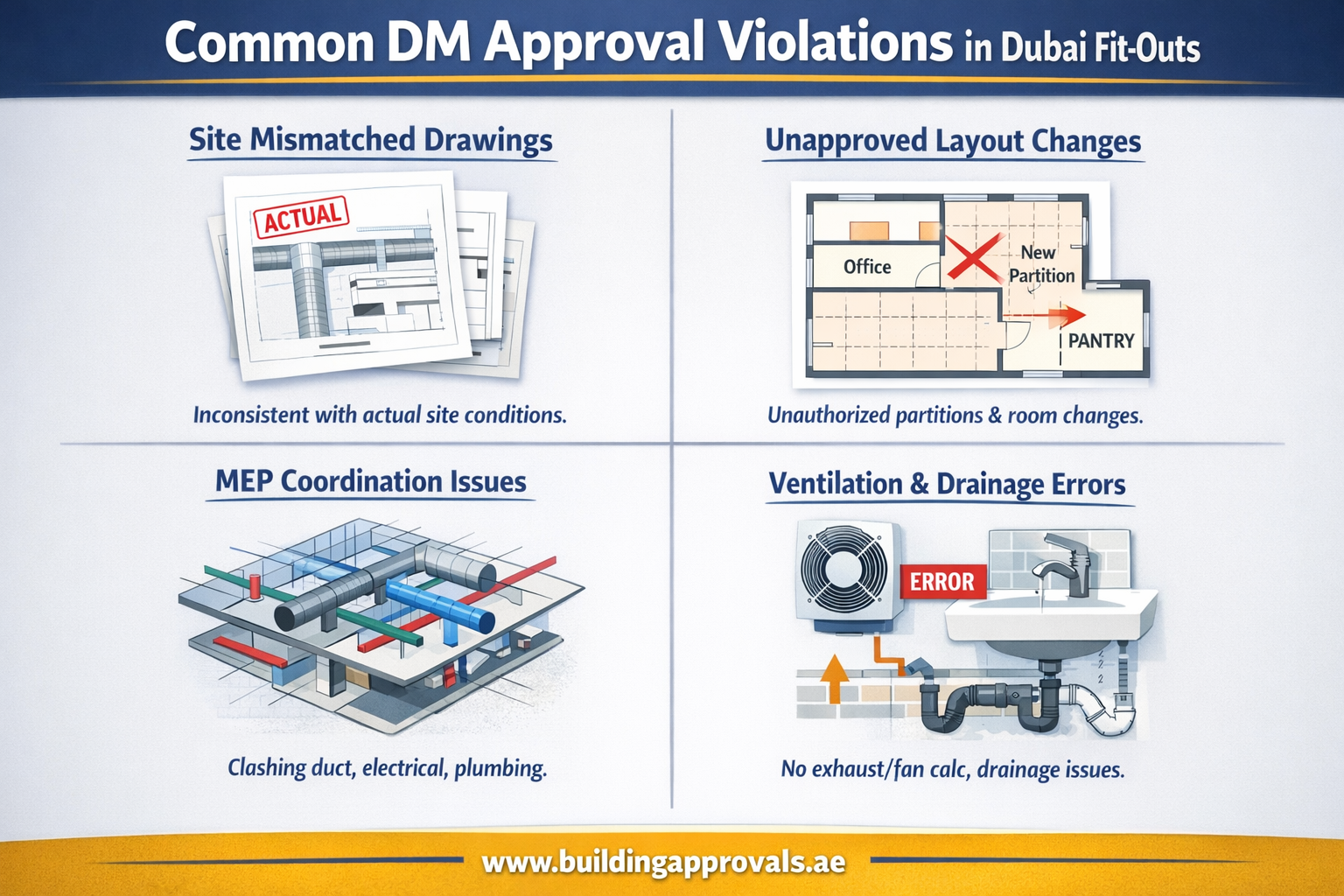
1) Drawings Don't Match the Actual Site Condition
What it looks like:
- Actual ceiling heights differ from the drawings
- Columns/shafts are missing or shifted
- Unit boundary lines don't match lease drawings
- "As-built" base plan not verified
Why does it get flagged? DM reviewers expect your proposed works to align with real constraints and existing approvals. Mismatches create risk during the inspection and completion stages.
Fix:
- Start from a verified base plan (landlord + site measure)
- Cross-check unit area, gridlines, and key fixed services
- Prepare a clean "existing vs proposed" comparison sheet
2) Unapproved Layout Changes (Scope Creep)
What it looks like:
- Added partitions after submission
- Shifted doors, counters, or storage rooms
- Changed use of spaces (store → pantry, office → training room)
Why does it get flagged? Even small changes can affect egress, ventilation, power load, plumbing routes, and compliance.
Fix:
- Lock scope before submission
- If changes are unavoidable: revise drawings + re-submit before executing
3) Architectural & MEP Coordination Errors
What it looks like:
- Diffuser positions cut through the lighting layout
- FCU/duct routing clashes with the ceiling design
- Sprinkler/Smoke detector locations not coordinated with the reflected ceiling plan
- Electrical DB location conflicts with joinery or access
Why does it get flagged? Poor coordination is one of the biggest causes of "revise and resubmit," and it increases inspection failure risk.
Fix:
- Produce coordinated plans: Architectural + HVAC + Electrical + Plumbing
- Add sections/details at congested areas (toilets, pantry, reception, bulkheads)
4) Ventilation & Exhaust Non-Compliance (Especially F&B / High Occupancy)
What it looks like:
- No fresh air strategy shown
- Toilet exhaust is not sized/indicated properly
- Kitchen exhaust route unclear, wrong discharge point, or missing filtration notes
Why does it get flagged? Ventilation affects health, comfort, and safe operation. DM and related authority requirements often demand clear ventilation intent and calculations (where applicable).
Fix:
- Provide ventilation calculations where required
- Show duct routes, fan schedules, discharge points, and access for maintenance
5) Plumbing & Drainage Mistakes
What it looks like:
- Incorrect slopes, missing cleanouts
- No details for floor traps/gullies
- The pantry sink was added without a proper drainage route
- Water heater location not coordinated with ventilation and access
Why does it get flagged? Drainage errors cause real-world failures (odor, backflow, leakage), which often show up at the inspection stage.
Fix:
- Add isometrics and details where the routing is complex
- Show pipe sizes, slopes, tie-in points, and maintenance access
6) Incorrect Material Notes / Finishes That Trigger Objections
What it looks like:
- "Generic" finish notes with no compliance specs
- Missing key notes for wet areas (waterproofing system, floor finish build-up)
- Incomplete ceiling/partition specifications
Why it gets flagged: Approval requires clarity on what's being built, where, and to what spec.
Fix:
- Provide a finish schedule with clear references
- Include typical details for partitions, ceiling, waterproofing zones, and floor build-ups
7) Green Building / Sustainability Gaps (When Applicable)
Dubai Municipality issues Green Building Regulations & Specifications that affect how buildings and services are designed and commissioned in Dubai.
Common pitfalls:
- Missing commissioning/technical notes for building services (where required)
- Not aligning the MEP approach with the sustainability requirements for the project scope
Fix:
- Align the fit-out MEP strategy with the building's existing green requirements
- Keep documentation ready for any commissioning-related requests
8) Missing Documents, NOCs, or Incorrect Submission Set
What it looks like:
- Missing landlord NOC / building management requirements
- Trade license/tenancy documents are inconsistent
- Drawings not stamped/attested as required by the submission route
Why does it get flagged? A technically correct design can still be delayed if the application package is incomplete.
Fix:
- Use a standard document checklist per project type (office, retail, restaurant, clinic, etc.)
- Assign one person to quality-check the entire submission before uploading
How to Avoid DM Violations (Practical Checklist)
Use this as a "pre-submission" gate to reduce rejections.
Step-by-step (works for most fit-out approvals in Dubai)
1. Confirm authority + location rules
- Is it DM-only, or a free zone/master developer authority?
- This decides formats, portals, and required NOCs.
2. Freeze the base plan
- Verify dimensions and existing services on site.
- Lock unit boundaries and fixed elements.
3. Coordinate Architectural + MEP
- Resolve ceiling clashes, access panels, and equipment clearances.
- Ensure plans, legends, and revisions match across all disciplines.
4. Add the missing "reviewer-friendly" pages
- Key notes, schedules, typical details, and sections at congested zones.
- Clear scope definition: "what stays" vs "what changes."
5. Validate compliance-sensitive areas
- Toilets, kitchens/pantries, high occupancy areas, exhaust routes, drainage tie-ins.
6. Prepare for inspection from day one
- Site execution must match approved drawings.
- Keep the approved IFC set on site + revision control log.
Pro tip: Most delays are not "big violations"; they're small inconsistencies: one drawing shows a door swing, another doesn't; diffuser count differs from the schedule; the DB location shifts without updating sections. A consultant-led QA pass before submission often saves multiple resubmissions.
Quick Red Flags That Usually Trigger Rejection
- "Proposed" drawings without an existing base reference
- No coordinated reflected ceiling plan (RCP) for busy ceilings
- Ventilation intent not shown for toilets/pantries/kitchens
- Drainage routes are missing for new sinks/floor traps
- Generic notes (no specs, no schedules, no details)
- Missing NOCs / incomplete package upload
FAQ
1) What is the most common reason for DM Approval rejection in Dubai fit-outs?
Usually, it's drawing inconsistencies (architectural vs MEP), missing documents/NOCs, or unclear ventilation/drainage details that reviewers need to validate compliance.
2) Can I start fit-out work before DM Approval is issued?
Starting work before required approvals can lead to stop-work issues and complications during inspections. It's safer to proceed only after the correct approval route is cleared for your scope.
3) Do office fit-outs always need Dubai Municipality approval?
Many office interior changes do require approvals, especially when layouts, partitions, ceilings, or MEP systems change. Requirements vary by building, location, and authority route.
4) How can I reduce DM fit-out approval delays?
Use a submission checklist, properly coordinate drawings, verify the base plan, and ensure your documents/NOCs are complete before uploading.
5) Does DM check green building requirements for fit-outs?
Depending on the project scope and building requirements, green building regulations can affect the MEP approach and documentation.
Key Takeaways
- DM Approval delays usually come from coordination errors, unclear ventilation/drainage, or incomplete submission sets.
- Freeze your base plan, then coordinate Architectural + MEP before uploading.
- Add reviewer-friendly details: schedules, notes, sections, and typical details.
- Treat approvals like inspection prep: build exactly as approved and maintain revision control.
- For faster outcomes, run a QA check on drawings + documents before submission.
Ready to Apply?
- Official portal for DM approval: https://www.dm.gov.ae/
- Get in touch with us: +971 589575610 to get specialist guidance now - https://www.buildingapprovals.ae/contact
Need Help with Building Approvals?
Our expert team is ready to assist you with all your Dubai building approval needs.
Get in Touch